


How to Dial In Espresso at Home: A Beginner's Guide
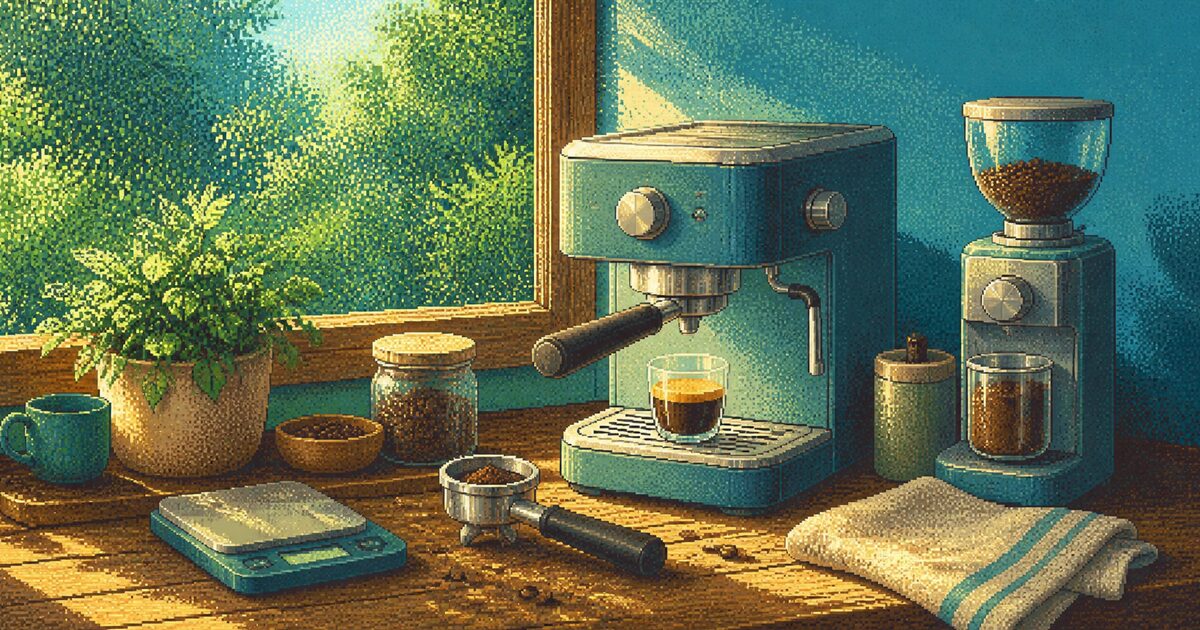
Espresso is the one brew method where being off by half a gram of grind setting is the difference between a sour, thin shot and a syrupy, bitter one. That's not a flaw — it's what makes dialing in satisfying once you understand the loop. Here's the process, stripped of the mysticism.
Start with a baseline recipe
Before touching anything else, set a fixed target: 18g of ground coffee in, 36g of espresso out, in 25–30 seconds. That's a 1:2 ratio, and it's the standard starting point most home baristas and cafés converge on for a medium roast. Preheat your group head and portafilter if your machine allows it — a cold group pulls heat out of the shot and skews your results.
Weigh your dose on a scale. Eyeballing it is the single easiest way to make every other adjustment meaningless, because you won't know if a bad shot came from grind, dose, or tamp.
Get the grind size right
Espresso needs a finer grind than any other common brew method — think table salt to baker's sugar, slightly gritty but not powdery between your fingers. On most grinders with a 10-point scale, that's somewhere in the bottom two settings, but every grinder is different, so use the number as a starting point, not gospel.
Grind size is the single most important variable in home espresso — more important than tamp pressure, water temperature, or which portafilter basket you use. If your shot time is off, this is almost always the first thing to adjust.
The six-step dial-in loop
- Set a baseline — 18g in, 36g out, 25–30s target.
- Prep the puck — dose, distribute evenly (a quick WDT stir helps), tamp level and firm.
- Pull the shot — start the timer the moment the pump engages.
- Read the result — taste it, and check the time and yield against target.
- Adjust one variable — grind size only, one step at a time.
- Repeat — don't change two things at once, or you won't know what fixed it.
Reading the taste
- Sour, thin, watery → shot ran too fast → grind finer.
- Bitter, harsh, ashy → shot ran too slow → grind coarser.
- Balanced but flat → try adjusting ratio (e.g. 1:2.2) before touching grind again.
Give yourself permission to dump a few shots. Dialing in a new bag of beans — especially right after roasting, when beans are still degassing — routinely takes 3–6 shots before it clicks. Once it does, that setting will hold for most of the bag, with only minor nudges as the beans age.
A few things that quietly ruin shots
- Stale beans. Espresso is unforgiving of beans past their peak (roughly 5–25 days post-roast is the sweet spot for most light-to-medium roasts). If your shot won't taste right no matter what you do, suspect the beans before the technique.
- Uneven tamp. A tamp that's angled even slightly will channel water through the low-resistance side of the puck, over-extracting part of the shot and under-extracting the rest — you'll taste both sour and bitter in the same cup.
- Inconsistent dose. ±0.5g might not sound like much, but at an 18g dose that's nearly 3% — enough to shift your ratio and throw off shot time.
Once your baseline is dialed, the fun part starts: nudging ratio and temperature to chase the specific flavor notes in a bean. But that's a project for once the fundamentals are boring and repeatable — which, honestly, is the goal.